

Welcome to


Agro Ecology Central West (AECW) is an innovative ag-tech business delivering Biological Control solutions to small and medium sized orchards and agricultural enterprises.
Biological Control as easy as A.B.C
We specialise in Augmented Biological Control (ABC).
ABC involves the release of commercially reared “beneficial” insects into orchards threatened by rising pest levels.
The introduced “beneficials” selectively outcompete the pest through a process of predation (consumption), parasitism or both. After several reproductive cycles (generations) of the introduced beneficial species, the pest population falls to a point where it is no longer an economic threat.
ABC is used successfully in the principal hazelnut growing regions of the world.
Orchardists use ABC and Integrated Pest Management (IPM) practices to suppress borers, aphids and stinkbugs, reducing or eliminating their reliance on broad spectrum chemical insecticides.
Worldwide growers and crop protection specialists are choosing Biological Control practices over insecticides to more sustainably manage damaging pests.
Welcome to the club!
PODS for Productivity
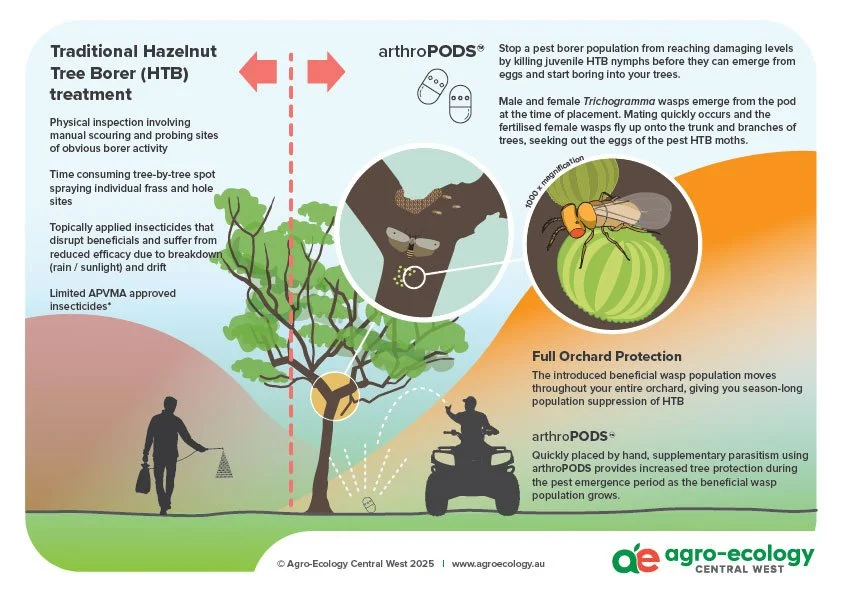
Our arthroPOD delivery system saves orchardists time, effort and money.
Avoid time consuming tree-by-tree inspection and physical scrubbing of individual borer sites.
Let nature do a more complete job for you.
Push pests from your trees out to orchard borders and beyond.
NOW, more than ever is the time to make every orchard input count.
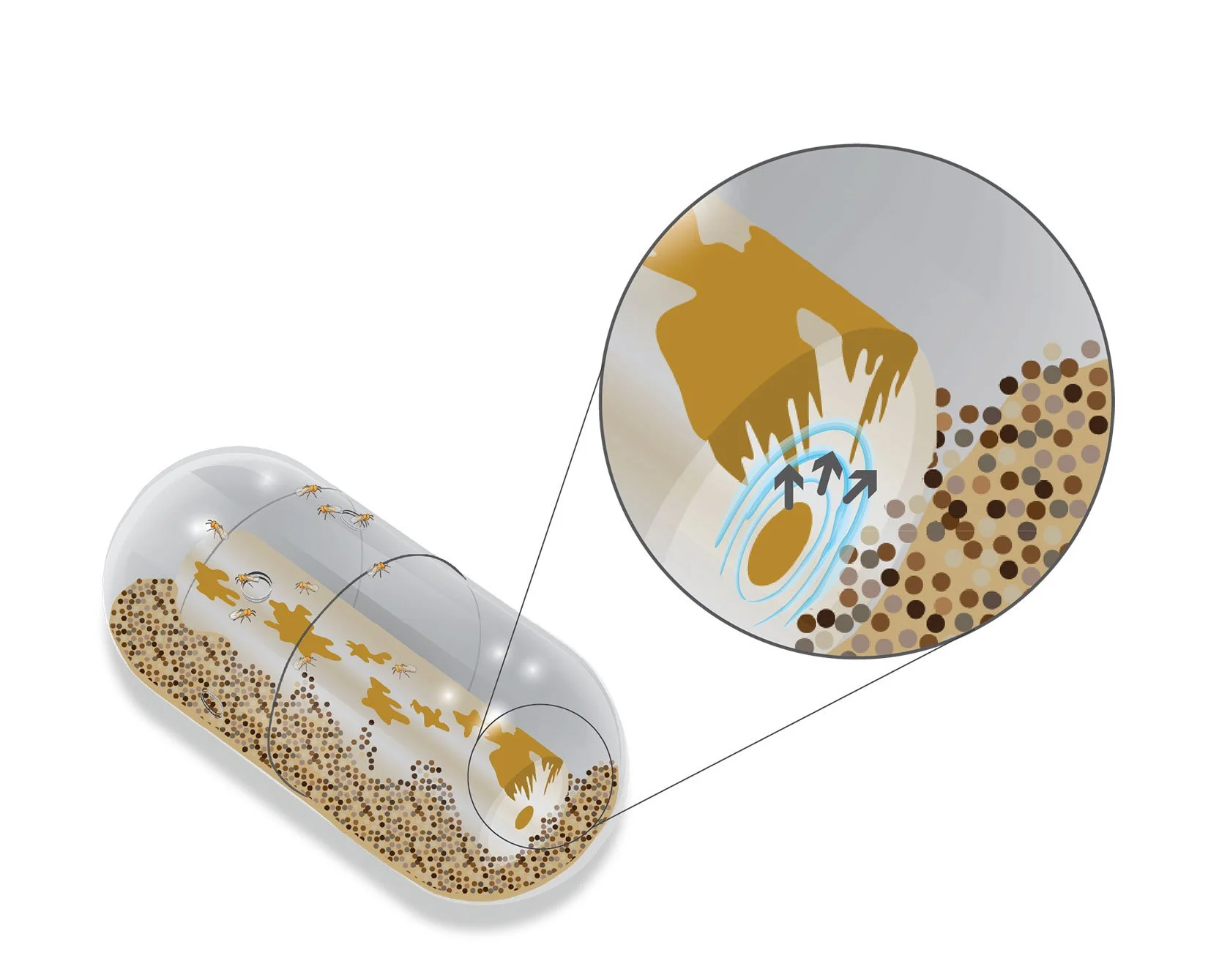
Portion Control meets Biological Control.
arthroPODS beneficial insect delivery platform
We specialise in the release of a parasitic wasp, Trichogramma.
Worldwide Trichogramma are the most commonly reared beneficial insect species used in biological crop protection.
Trichogramma are egg parasitoids.
Female Trichogramma wasps deposit their eggs into eggs previously laid by pest moths. This kills the developing pest larvae, and allows the immature Trichogramma wasp to continue developing until it hatches and emerges from the pests egg at the expense of its “host”.
Trichogramma wasps eat and parasitise a wide variety of pest moth eggs and can quickly overwhelm a growing pest population.
More than 40 million Ha’s of crops worldwide rely on regular releases of Trichogramma to protect them from damaging pests and allow farmers to reduce their use of chemical insecticides.
Out of Sight - Front of Mind

Our Biological Control efforts focus on nut crops.
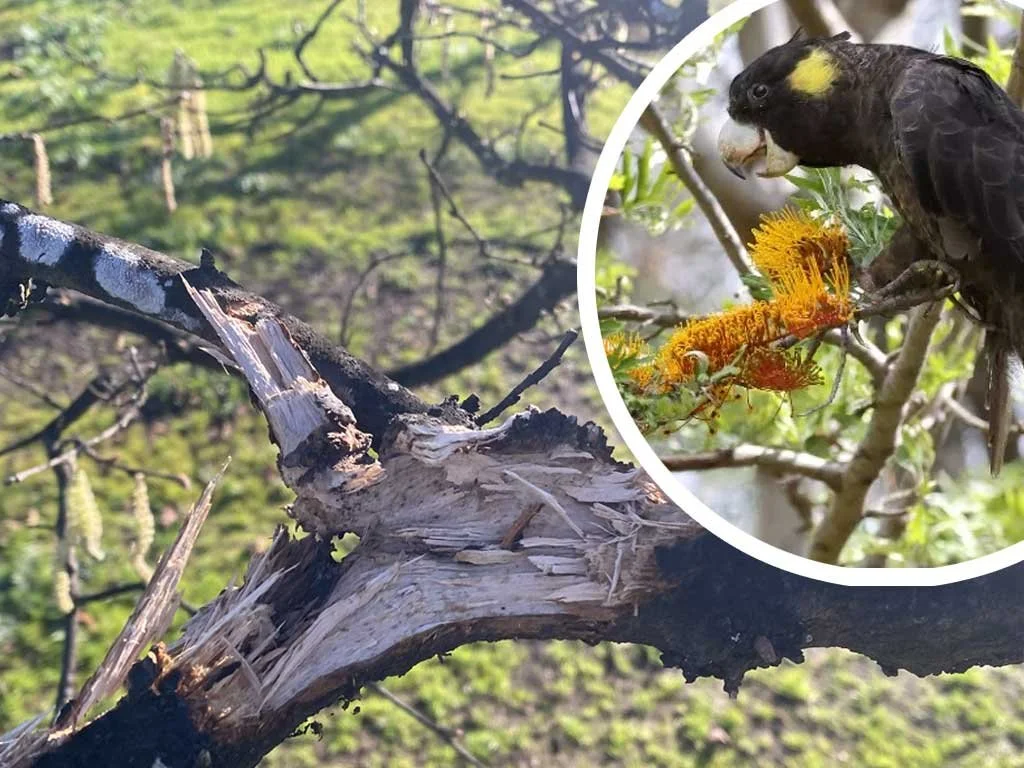
We support a network of growers adopting ABC practices that suppress a damaging pest, the Hazelnut Tree Borer (HTB). (Maroga melanostigma; Pecan Stem Girdler, Fruit Tree Borer)
The presence of HTB has long been thought to limit the lifetime potential of orchard assets.
Tunnelling larvae can reduce nut yields, weaken affected limbs to the point of breakage and predispose trees to other diseases.
Left untreated, it is not uncommon for HTB larvae to kill entire trees through ringbarking.
Visit our gallery to see the pest at work.
Orchardist Technical Guide
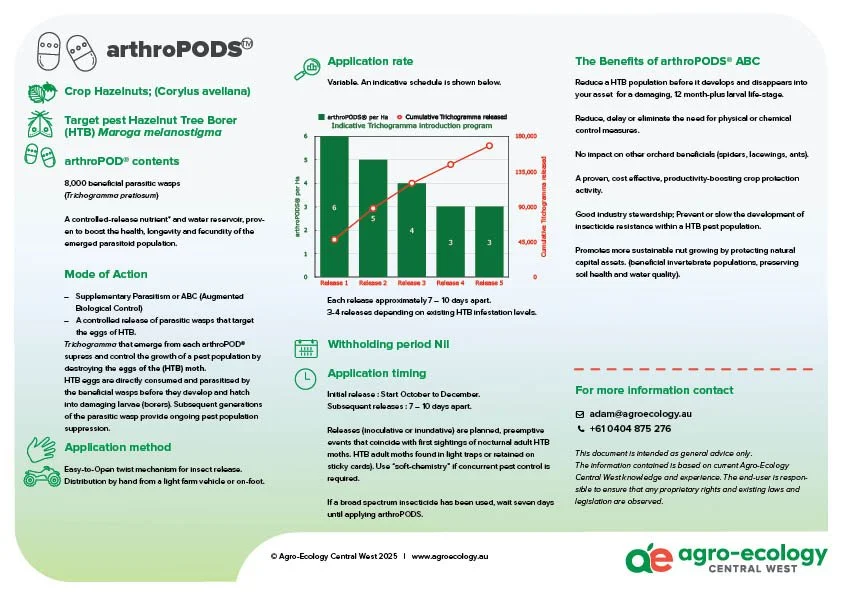
Question: Why do I need multiple arthroPOD releases. Isn’t one enough ?
Answer: Multiple releases (3-4) of Trichogramma are required to coincide with the 6 - 8 week window when the pest borer pupates and emerges from infested trees as a winged adult moth. Parasitism from Trichogramma wasps is most effective when fresh pest eggs are available. Multiple arthroPOD releases ensure there is sufficient beneficial wasps to inundate a rapidly emerging population of sexually mature adult moths.
Question: Do I have to apply arthroPODS every season?
Answer: mmmm Maybe. It’s a question of risk!
The pest has a complex lifecycle, that is not yet well understood by scientists. From a population of damaging larvae, only a proportion (possibly just 50%) emerge from your trees each season, leaving the balance of pests hidden and secure within the tree, free to continue their tunnelling activity or as dormant pupae. For full suppression and control of an existing pest population, it might take 2 even 3 seasons of arthroPOD applications to demonstrate a measurable effect.
In other agricultural cropping systems, releasing beneficial insects at low inoculative levels has a become a form of “insurance” policy and is now integrated into standard agronomic practices.
The Benefits of Biological Control.
“Between too early and too late there is never more than a moment.”
Franz Werfell
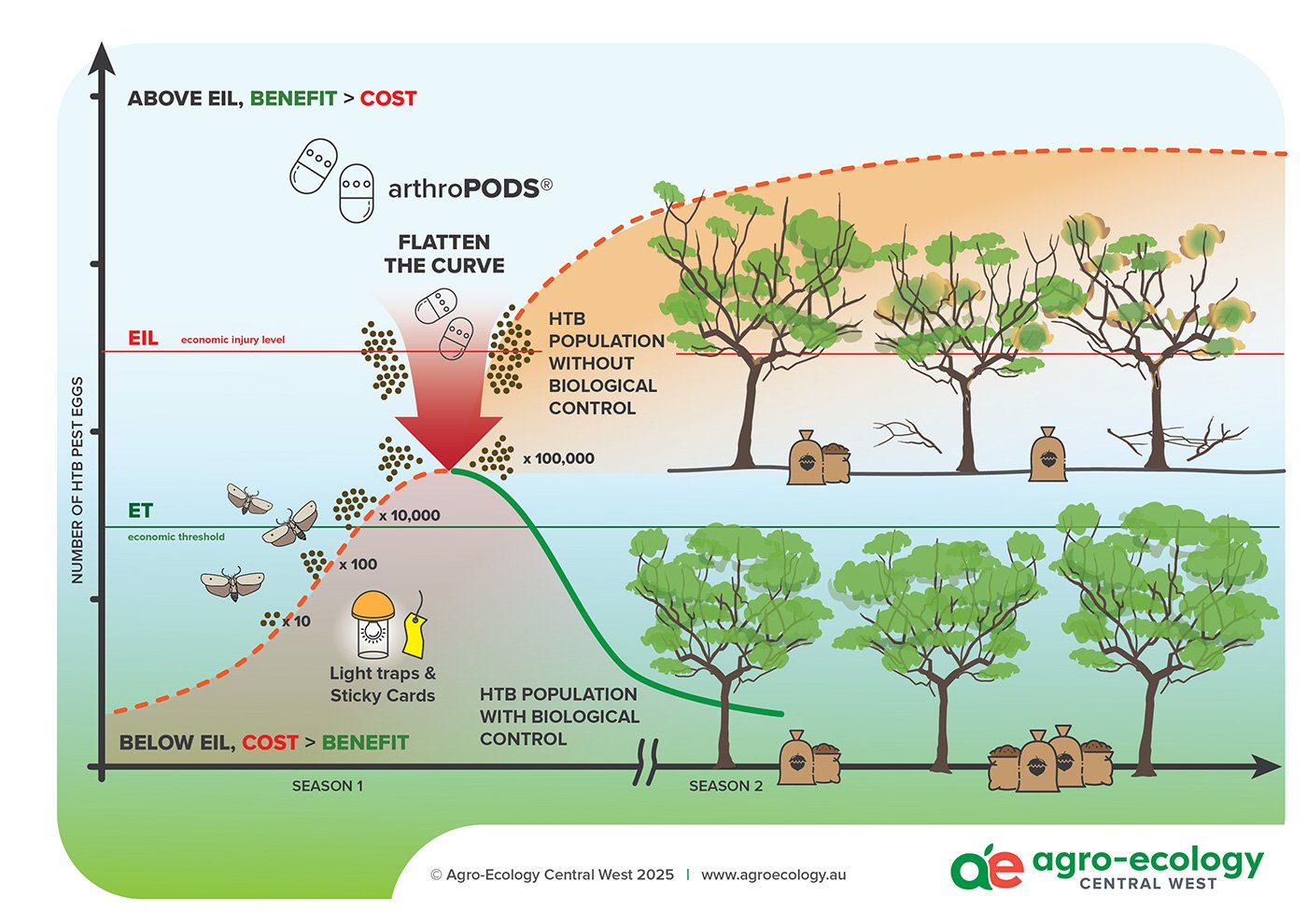
Pest moths begin to emerge and lay their eggs in orchards from mid September.
This is the time to act. (ET)
Trichogramma introduced among your trees when pest egg numbers are relatively low, allows the introduced “beneficial” insects to out-compete the pest, flattening the rate of pest population growth before it can reach costly damaging levels. (EIL)
Left unchecked, season-after-season growth of the HTB pest will result in borer levels becoming endemic and overall orchard health and yields compromised.
The Economics of Biological Control
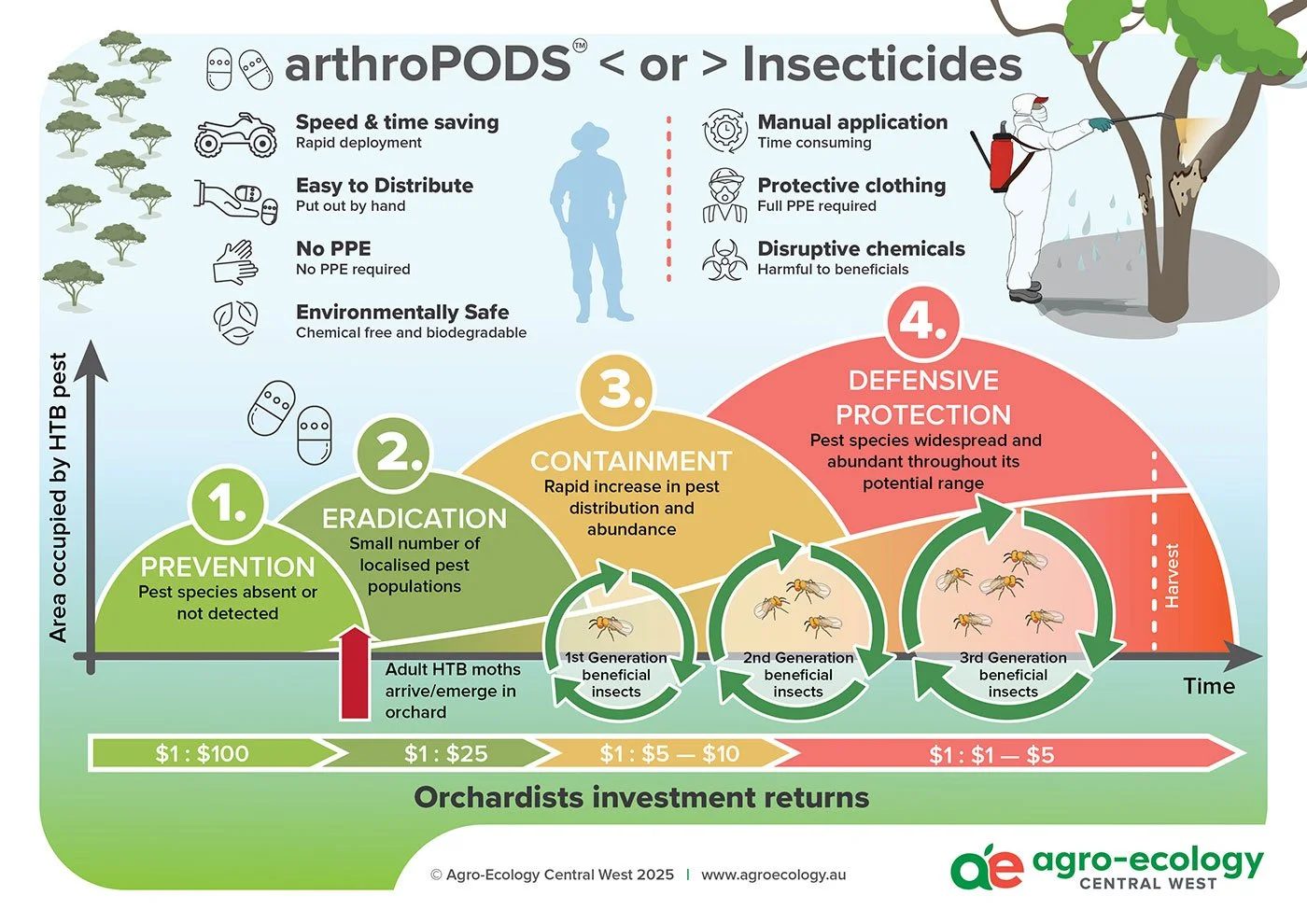
ABC - Augmented Biological Control works best as a preemptive pest suppression treatment in your orchard.
ABC lets you conserve another of your assets, “Natural Capital” - spiders, lacewings, predatory beetles and a range of other beneficial invertebrates. These “assets” might otherwise be killed off by choosing a broad-spectrum insecticide over biology.
Traditional chemical insecticides loose their efficacy from the moment they are applied. Sunlight, rain, wind and application challenges all conspire to reduce their effectiveness.
Introduce a healthy, vigorous population of “beneficials” when a pest population is small and watch your investment generate real returns.
arthroPODS - Crop Protection for the NEXT GENERATION!.


Agro-ecology is a member of
“The free thinking of one age is the common sense of the next“
Curious?
Get in Touch
If you’d like to find out more about our products, please call or leave a message.
Call Adam Perkins on 0404 875 276