
Discover key stats on Hazelnut Tree Borer (HTB)
Hazelnut Tree Borer (HTB) by the numbers. Hopefully you’ll find these statistics less boring than the pest itself! Read On.
The Headline Numbers
Observed levels of pest moth Maroga melanostigma (HTB) are on the rise. Up about 20%.
Almost 90% of moths are seen between October and January, with the most moth observations occurring in January
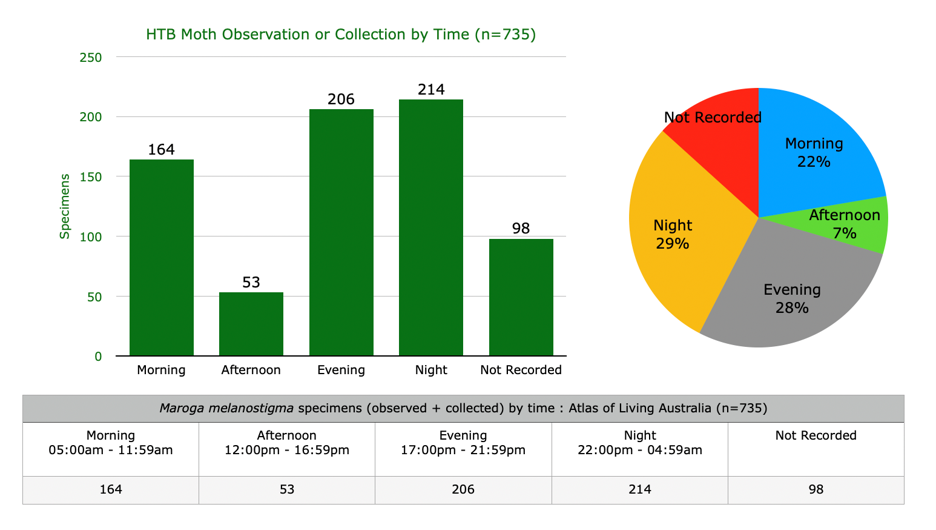
The moths are nocturnal, with almost 60% of sightings made between 17:00pm and 05:00am.
Commentary & Implications for Biological Control of the Pest
Are observed levels of the pest really on the rise? Hmmmm; We need to be a little cautious in our interpretation of this data. The graph below is drawn up over a calendar year - but moths emerge on months either side.
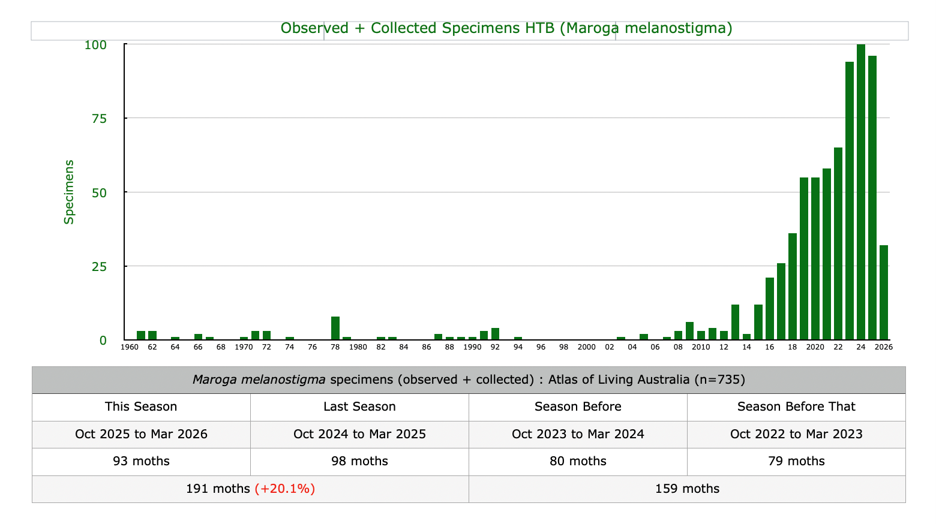
The best way to look at it is probably a Year-on-Year comparison. See the table for my analysis of four “seasons” worth of observations.
Moth numbers for the past two seasons vs the earlier two seasons show a 20% uptick in observations. If you squint a bit and look at the overall shape of the curve, I think we can assert that pest moth levels are increasing …. However, a bit more caution could be warranted.
Ecology vs Technology
We should keep in mind that smartphone based apps like inaturalist are now ubiquitous in the hands of ecologists, entomologists and citizen scientists. These apps have made reporting of observations much easier - so the 20% plus increase may have a technology basis, and not just an ecological one.
AECW’s hypothesis for what it’s worth is that moth levels are up a bit and will probably continue to increase as the weather warms. Pest moths are finding their natural habitats; native trees, eucalypts, black wattles less attractive as the timber and undergrowth drys out.
When presented with a choice, Maroga melanostigma moths think there’s a better chance of continuing their lifecycle in your thin barked, sap rich, well watered hazelnut trees!
Biological Control of the pest HTB (Maroga melanostigma)
Sweet Spot. Timing is everything. The graph below shows moth sightings by month at a national level.
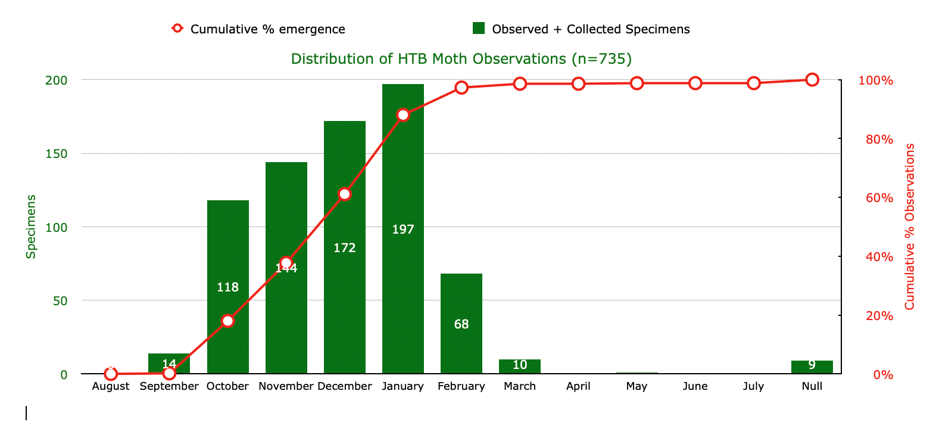
The best time to begin introducing Trichogramma egg parasitoids into your orchard is from mid October to Late November. For Trichogramma to effectively disrupt the lifecycle of the moth, there has to be a small - but sufficient number of pest moths already laying their eggs.
Weekly introductions of relatively large amounts of Trichogramma over 4 to 5 weeks soon tip the ecological balance in favour of the released beneficial wasps. Trichogramma predate and parasitise the eggs of the pest moth - killing them. Moth larvae are prevented from hatching and can no longer burrow back into your trees for another damaging 12 month lifecycle.
Don't waste your time looking for moth specimens during the day. They’re very difficult to find when they flatten their bodies and wings against the dappled grey bark of your trees. Specialist light traps or sticky cards hung from trees near known borer sites are your best chance at trapping a specimen.
Source of Truth.
The Atlas of Living Australia is our national biodiversity database, hosting almost 90 million records on Australian insects, plants, animals and microorganisms from museums, universities and citizen scientists. On the 11th March 2026 - I extracted 735 records of nationwide Maroga melanostigma findings dating back to January 1961. (https://www.ala.org.au).
For those of you who are particularly keen on data science, I have combined a couple of separate data sets from the CSIRO and NSW DPI about the moth - one in particular involves its presence in a NSW pecan orchard that may interest growers. You can explore this data by going to my site on Tableau.