
Pesticide Use Trends: The Bright Side of Australian Hazelnuts
Latest UN Food & Agriculture Organisation (FAO) report on pesticide use - Australian Hazelnuts grown in “Clean Green” conditions.
A couple of weeks ago the UN’s agency, the FAO published its annual report on the worldwide use of agricultural pesticides. This is one of the more closely followed publications by those of us working in Biological Control, Agronomy and Ecology.
It has some gloomy headlines
Total pesticide use in agriculture in 2024 was 3.92 million tonnes of active ingredients
a 5 percent increase from 2023
an 18 percent increase in a decade,
pesticide use has more than doubled since 1990.
pesticide application stands at 2.49 kg active ingredient per hectare of cropland. (+5% YoY)
A Ray of Light
If you’re prepared to sift through the numbers a bit, a couple of positive insights emerge that present Australian grown hazelnuts in a positive light.
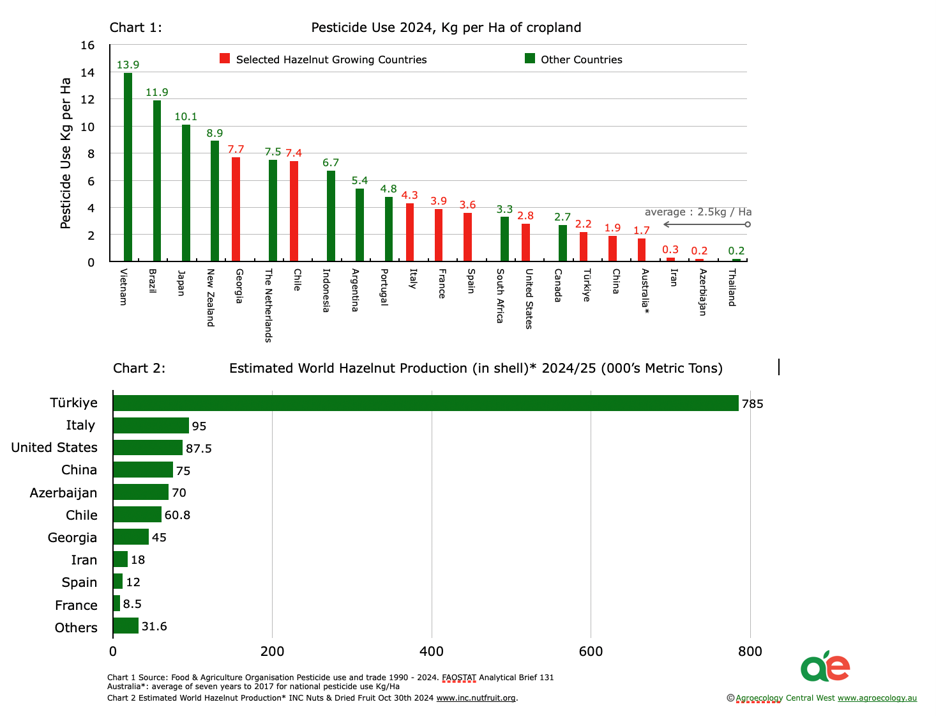
Australia sits on the right side of the curve. Our hazelnuts are grown in a country that has a lower than average pesticide use.
Good news too for the world’s largest hazelnut producer, Türkiye and fast emerging growers from China. Both countries lie under the FAO’s average 2.5 kg / Ha of pesticides applied. China is recognised as a world leader in Biological Control practices used for crop protection.
Another six countries, Georgia, Chile, Italy, France, Spain and The United States (who collectively produce close to 25% of all hazelnuts), sit above the FAO’s average.
“A statistician is a person who can go directly from an unwarranted assumption to a preconceived conclusion” - Anon
FAO data are often noisy, late and imperfect.
Our interpretation doesn’t suggest that produce grown from a country with an above average use of pesticides is any less healthy or of reduced quality.
The FAO’s data lacks sufficient detail to explore individual crops or draw more nuanced conclusions.
The data is useful however as a comparative evidence base for countries and crop sectors looking for ways to improve their green credentials in a timely, measured, sustainable fashion. Brazil stands as a good example.
Out of the 197 countries captured in the FAO’s 2024 survey, Brazil presented with the 28th-highest application rate of pesticides - Chart 1, but over the last five years chemical use has stabilised.

In March 2024 Brazil announced that for the first time, approvals of biological pest control products including the use of parasitic and predatory insects exceeded that of traditional agro-chemicals. The country is reporting that more than half its farms are now using some form of biological control. (1)
Chart 4 shows a couple of “Hazelnut Competitor Countries” - Chile and Italy that are steadily reducing the amount of pesticides in their agricultural environments .

Australia is currently in an enviable position with respect to reported pesticide use in crops.
Growers can continue to produce high quality nuts in a low pesticide environment by implementing Integrated Pest Management practices and actively investigating Biological Control measures before reaching for the sprayer.
Buyers of imported hazelnuts might think twice if they knew of these results!
For more interactive versions of these charts visit https://public.tableau.com/app/profile/adam.perkins8435/viz/FAOStatWorldwideAgriculturalPesticideUse/Story1?publish=yes
Reference:
1. Allison E. Registration of biological pest control products exceeds that of agrochemicals in Brazil May 2024. Agência FAPESP. Available at https://agencia.